
BEGINNER GUIDE · PC SUMMONER’S RIFT
How to learn League of Legends as a beginner
Start with the goal, your champion and one useful decision at a time. You can learn the basics before memorising a roster or an item shop.
This guide gives you a practical order for learning. LeagueLingo’s interactive course follows the same foundations with short explanations, quizzes and flashcards. This page is free to read without an account; the interactive course requires a free account and an internet connection.
01 · KNOW WHAT YOU’RE WORKING TOWARD
Destroy the Nexus, not just enemy champions
The Nexus is the structure in each team’s base. Destroying the enemy Nexus wins the match. A champion is the character a player controls. Defeating enemy champions can give your team an opportunity, but a kill alone does not end the game.
Turrets are defensive towers; inhibitors are structures deeper in each lane. Your team opens a route through enemy structures to reach the Nexus. Minions are computer-controlled units that move down lanes. Allied minions can take turret attacks while you damage a turret, but they do not make the situation automatically safe.
02 · FIND YOUR STARTING JOB
Learn three lanes and five positions
Top, mid and bot are lanes: paths between the bases. The jungle is the area between lanes, with neutral monster camps. The river crosses the map between the two sides.
| Position | Where to begin |
|---|---|
| Top | A solo lane: collect resources, watch threats and choose safer exchanges with opponents. |
| Mid | A solo lane in the centre: learn the same resource and safety fundamentals. |
| Bot | Usually shares bottom lane with Support and prioritises collecting minion gold. |
| Support | Usually starts beside Bot, protecting teammates and helping them see approaching threats. |
| Jungle | Usually collects early resources from monster camps while looking for useful help elsewhere. |
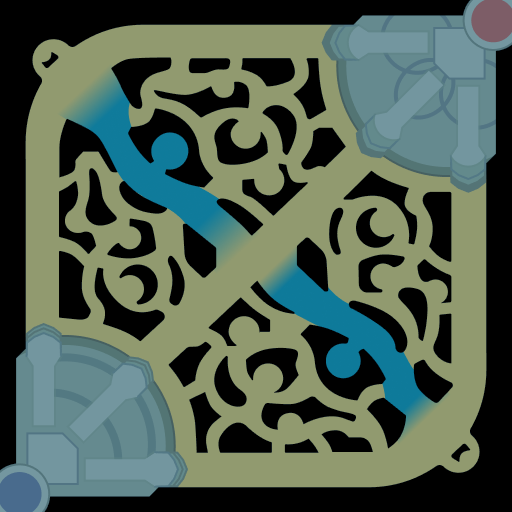
These are starting assignments. A position does not force one champion type. Modes, position-specific tasks and item rules can differ; read the guidance for your match.
03 · UNDERSTAND YOUR TOOLS
Read one champion’s kit before learning everyone else
A kit is your champion’s collection of tools. A basic attack is its ordinary attack; abilities are its powers. A passive provides ongoing or triggered effects; check when it applies. Read each ability’s description for its effect, range, resource cost and cooldown.
In the default Point & Click controls, Q, W and E use basic abilities; R uses the ultimate, a special ability. Other control setups or custom keys can differ. Mana is one resource used to pay ability costs; some champions use another resource or no mana. A cooldown is the wait before using an ability again. Finishing that wait does not remove its resource requirement.
When shopping, keep scaling and damage type separate. Scaling means a stat contributes to an effect’s strength. Attack damage (AD) and ability power (AP) can strengthen effects that scale with them. Physical, magic and true describe damage types. Armour reduces physical damage; magic resistance reduces magic damage. Read the descriptions rather than guessing from an icon or colour.
 Long Sword · AD
 Amplifying Tome · AP
04 · COLLECT WITHOUT CHASING
Separate last-hit gold from nearby experience
A last hit finishes a minion. Normally, you need that finishing hit to earn its minion kill gold. You can receive experience from a dying enemy minion while close enough even when you miss the last hit. Gold buys items; experience helps you gain levels.
Practise timing without making every minion worth a dangerous fight. Position and special income rules matter too: Support’s income responsibilities differ from Bot’s. For a short trade—an exchange of damage or resources—consider enemy minions, health, distance and available abilities, then leave when the opening ends.
05 · NOTICE WHAT YOU DON’T KNOW
Use the minimap without treating a guess as a sighting
Vision is what your team can currently see. Fog of war hides areas it cannot observe. An enemy’s last-known position tells you where they were, not where they must be now.
The minimap is the small battlefield overview. Check it when you can safely spare attention. A missing enemy could have returned to base, moved or stayed nearby out of sight. A ward is a placed vision source. It can help answer a specific question about an approach, but it does not reveal the whole map or guarantee a safe route. Consider the danger of reaching a ward spot too.
06 · TURN AN OPENING INTO PROGRESS
Take useful objectives, then reassess
An objective is a useful map goal, such as a turret or a major monster reward. Before committing, check your team’s health, resources, nearby waves, information and available help. A nearby teammate is not automatically ready to fight.
A favourable fight might make a turret safely available. Use that opportunity if your team can carry it out, then check again before chasing another reward. Sometimes recovery and purchases are the useful next step. Smite, an extra spell commonly used by junglers, can help secure a monster’s finishing hit, but it does not make an unsafe attempt safe.
YOUR NEXT STEP
Choose one practice goal for the next game
- Learn one champion’s ability costs and cooldowns.
- Notice which minions you last-hit and which still give nearby experience.
- Separate a current enemy sighting from a remembered position.
- Before returning to base, name the recovery or purchase you need.
Keep the goal small enough to notice and repeat. Quizzes can help you check your understanding; applying a decision in a match takes practice too. App XP celebrates learning activity and is not an in-game rank.
The course includes 18 lessons, 120 authored questions, 72 flashcards and 18 optional mini challenges. Only server-confirmed account progress is saved.
Sources and scope
Based on LeagueLingo’s beginner curriculum, source-checked on 18 October 2026. Independent human gameplay review and beginner testing are still pending. Systems and controls can change; use current in-game descriptions for your match.